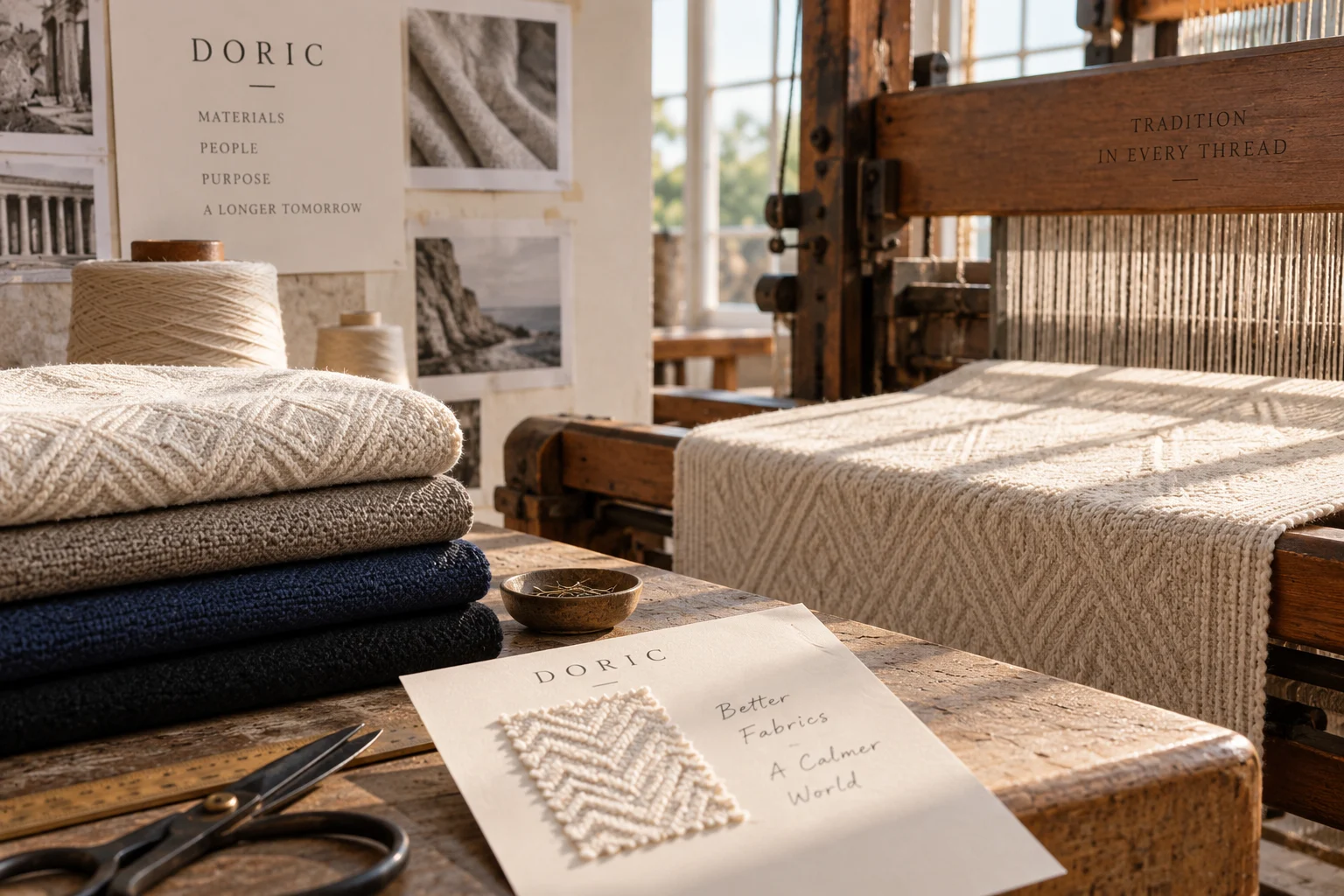
Most patterns are applied. They are printed, stamped or embroidered onto a finished cloth, and they sit on its surface. A jacquard is different. Its pattern is woven into the structure of the fabric itself, thread by thread, as the cloth is made.
A loom that could remember
The technique takes its name from Joseph Marie Jacquard, whose loom, patented in France at the beginning of the nineteenth century, used a chain of punched cards to decide which warp threads were lifted for each pass of the weft. Patterns that had once depended on an assistant lifting threads by hand could now be repeated precisely, row after row. The same principle — instructions stored as a sequence of holes — would later influence some of the earliest designs for calculating machines.
Why woven matters
Because the pattern lives inside the cloth, it moves with the fabric rather than sitting on top of it. It gives a surface a depth that a print cannot imitate: raised and recessed areas, a play of matte and sheen, a texture you notice with your hand before you notice it with your eye.
That kind of depth is exactly what the house looks for — a surface that reveals itself slowly. At a distance, a single colour. Up close, a structure.
The case for patience
Woven texture asks for time, and there is no shortcut that produces the same result. We think that is the point. Some things should not be hurried, and a garment meant to be kept for years is one of them.